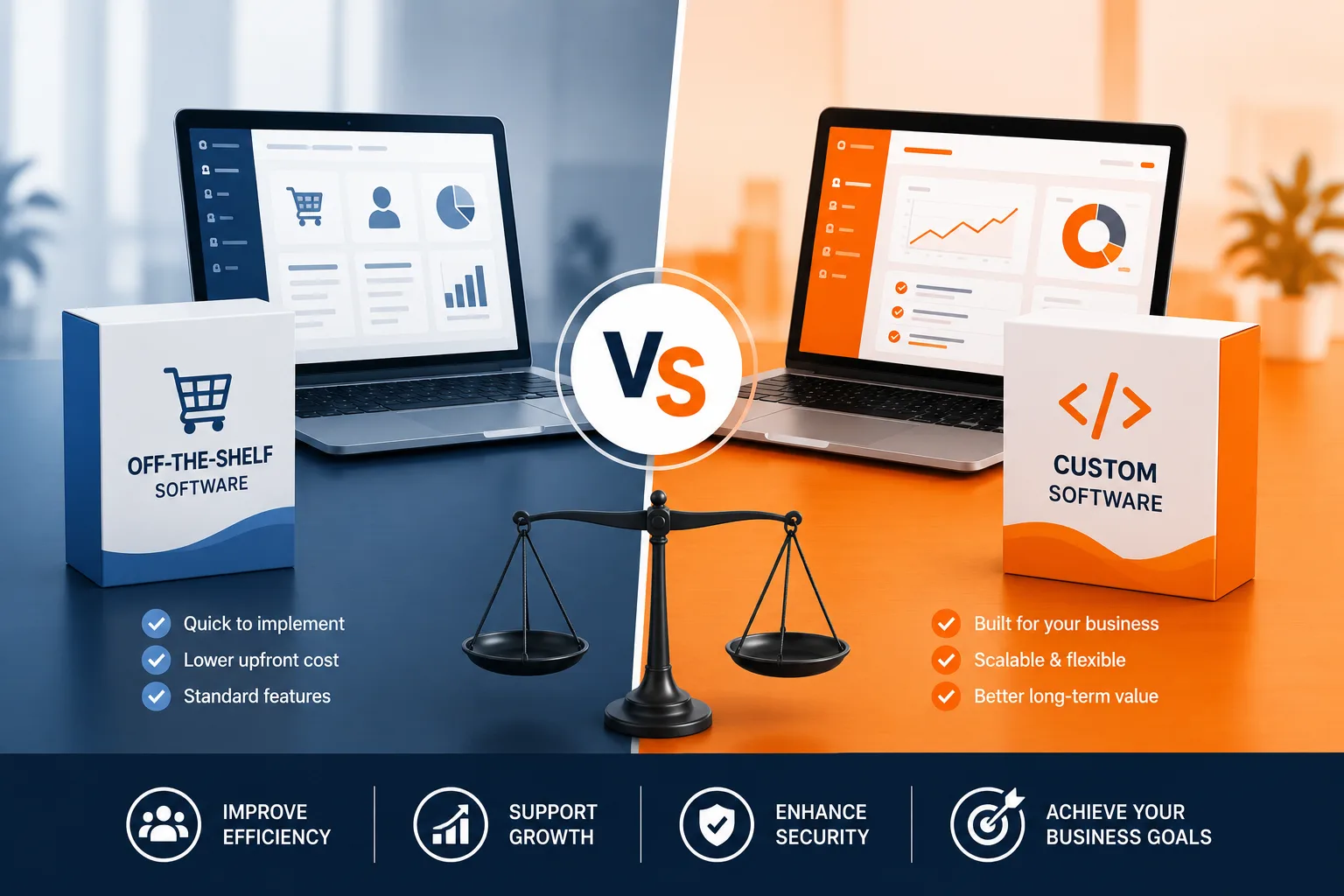
At some point, almost every growing Kenyan business hits the same wall: spreadsheets stop being enough, manual processes start causing errors, and off-the-shelf tools either can't do what you need or force you to change how you work to fit their limitations.
That's when the question comes up: do we buy ready-made software, or invest in something custom-built?
There's no single right answer — it depends on your business size, budget, and how unique your processes really are. Here's how to think it through.
What Is Off-the-Shelf Software?
Off-the-shelf software refers to pre-built solutions designed to serve a broad range of businesses — think generic accounting tools, standard point-of-sale systems, or template-based booking platforms. They're built once and sold (or licensed) to many customers with little to no customization.
Examples: generic accounting software, template website builders, standard inventory apps, off-the-shelf CRM tools.
What Is Custom Software?
Custom software is built specifically around your business's actual workflows, data, and goals. Instead of adapting your operations to fit the software, the software is designed to fit your operations — whether that's a school management system, a booking platform with M-Pesa integration, or an internal tool that connects departments that generic software can't.
Off-the-Shelf Software: Pros and Cons
Pros:
- Lower upfront cost — you're paying for something already built, not development time
- Faster to start using — often ready within days
- Established support and updates from the vendor
- Good for standard, common processes that don't differ much between businesses (e.g., basic bookkeeping)
Cons:
- Limited flexibility — you adapt your business to the software, not the other way around
- Feature bloat or feature gaps — you often pay for features you don't need while missing ones you do
- Ongoing license fees that add up over time, sometimes in foreign currency
- Poor fit for local realities — many international tools don't support M-Pesa, local tax requirements, or Kenyan business workflows out of the box
- Data lock-in — switching platforms later can be difficult and costly
Custom Software: Pros and Cons
Pros:
- Built around your exact workflow — no forcing your business into someone else's template
- Full ownership — no recurring license fees to a third party once it's built
- Scales with you — new features can be added as your business grows, rather than switching platforms
- Local integration built in — M-Pesa, local payment gateways, and Kenya-specific compliance can be designed in from the start
- Competitive advantage — a tool your competitors can't simply buy off a shelf
Cons:
- Higher upfront investment compared to buying an existing tool
- Longer development timeline — proper custom builds take weeks to months, depending on complexity
- Requires a reliable development partner for ongoing maintenance and support
How to Decide: 5 Questions to Ask
1. Are your processes genuinely unique, or fairly standard? If your business runs a fairly typical process — basic invoicing, for example — off-the-shelf may serve you well. If your workflow has quirks that generic software constantly fights against, custom is usually worth it.
2. Are you paying for workarounds already? If your team has built a patchwork of spreadsheets, WhatsApp groups, and manual double-entry to make an off-the-shelf tool "work," you're likely already paying — in time and errors — for a system that doesn't fit.
3. Do you need local payment integration? Many international off-the-shelf platforms don't support M-Pesa or local payment gateways natively. If accepting payments smoothly matters to your business, this is often the tipping point toward custom development.
4. How fast are you growing? A tool that works for 10 clients may buckle at 100. Custom software can be built with your growth trajectory in mind, avoiding a costly platform migration later.
5. What's your realistic budget and timeline? Off-the-shelf software makes sense if you need something running this week and your budget is tight. Custom development is a better fit when you're planning for the next 2–5 years, not just the next few months.
A Middle Ground: Customized Off-the-Shelf Solutions
It's not always all-or-nothing. Some businesses do well with a hybrid approach — starting with an off-the-shelf base and having a development partner customize or extend it (adding M-Pesa integration, for example, or building a connector to another system you already use). This can offer a faster, lower-cost path to something closer to a custom fit.
Real Examples Where Kenyan SMEs Typically Need Custom Software
- Schools needing a management system that handles fees, attendance, and communication in one place
- Tour and travel companies needing a booking system tailored to their specific packages and availability
- Auditors and consultants needing secure, structured client management tools
- Churches and NGOs needing donor and membership management systems suited to how they actually operate
- E-commerce businesses needing checkout flows with M-Pesa and other local payment methods built in natively
Get the Right Recommendation for Your Business
There's no universal answer to "off-the-shelf or custom" — the right choice depends on your specific processes, budget, and growth plans. At Blessedave Technologies, we help Kenyan SMEs assess exactly what they need, whether that's a straightforward off-the-shelf recommendation or a fully custom-built system designed around your business.
Talk to our team about the right software fit for your business at blessedavetechnologies.com.