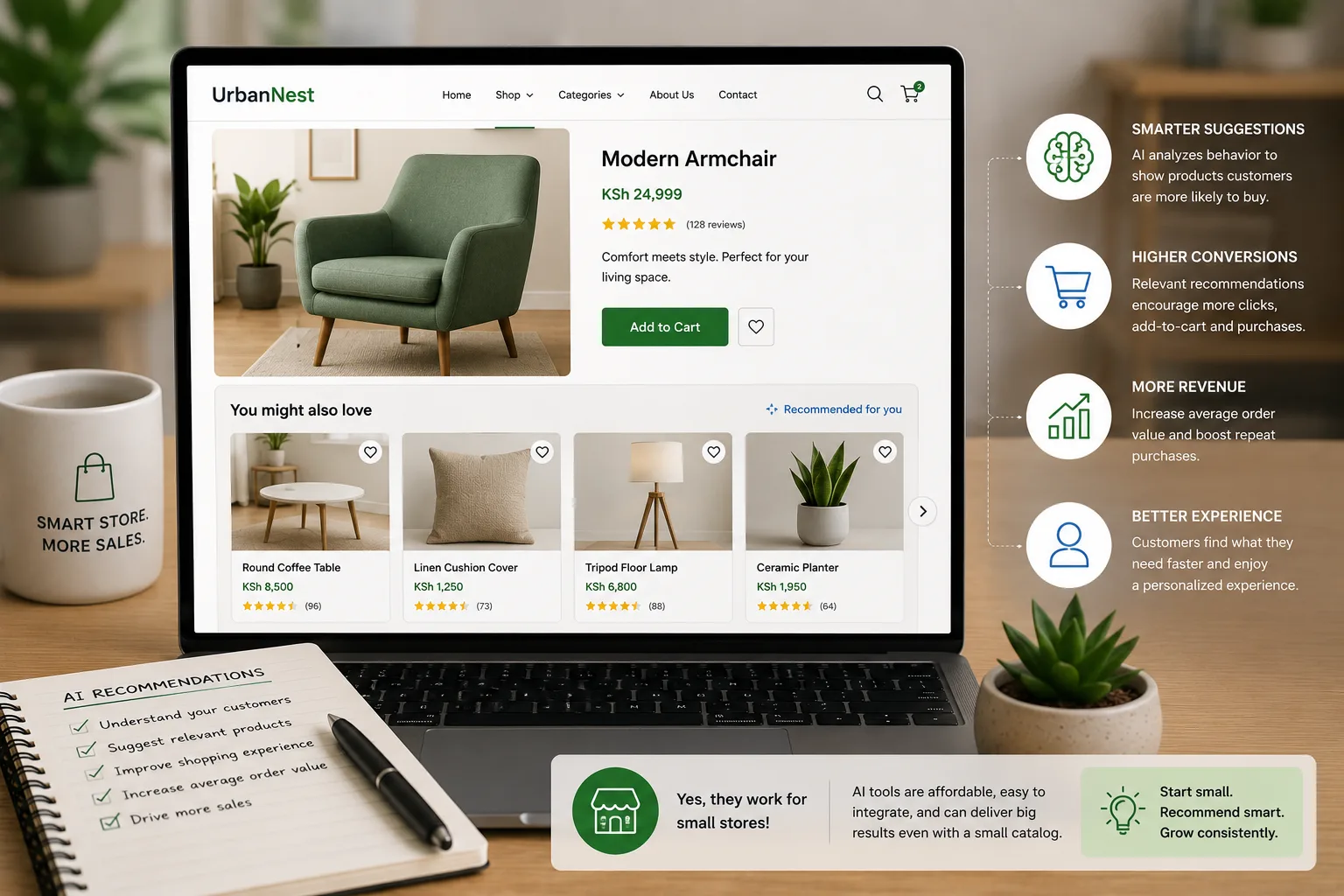
"Customers who bought this also bought..." — the kind of AI-powered product recommendation associated with Amazon and other large e-commerce platforms has become a familiar shopping experience. But does this technology actually make sense for a smaller Kenyan online store, or is it an unnecessary complexity better left to retailers with millions of products and customers? Here's an honest look at when AI recommendations genuinely help, and when they don't.
What AI Product Recommendations Actually Do
Recommendation systems analyze customer behavior — browsing history, past purchases, items viewed together — to suggest additional or related products a customer is statistically more likely to be interested in. Common formats include "frequently bought together," "customers also viewed," and personalized homepage suggestions based on browsing history.
The Case for Using Recommendations, Even as a Small Store
Increased Average Order Value
Well-placed recommendations — particularly complementary product suggestions at checkout — can meaningfully increase how much a customer spends per visit, since they surface relevant additional items the customer might not have actively searched for.
Improved Product Discovery
For stores with a reasonably sized catalog, recommendations help customers discover relevant products they wouldn't have found through search or browsing alone — particularly valuable for less prominent items that don't naturally surface through normal navigation.
A More Personalized Shopping Experience
Even simple personalization — showing recently viewed items, or suggestions based on browsing category — can make a store feel more attentive and modern, which contributes to overall customer experience and perceived credibility.
Where Recommendations Genuinely Struggle for Small Stores
Limited Data to Learn From
Recommendation algorithms improve with volume — more customers, more purchases, more browsing data to identify genuine patterns. A small store with limited traffic and sales history simply doesn't generate enough data for sophisticated AI-driven recommendations to perform meaningfully better than simpler, rule-based approaches.
Small Catalogs Limit the Value
If a store only sells a modest number of distinct products, the value of AI-driven discovery diminishes significantly — customers can reasonably browse the entire catalog manually, reducing the practical benefit recommendations would otherwise provide.
Implementation and Maintenance Cost
Sophisticated AI recommendation systems require setup, data integration, and ongoing tuning to perform well — costs that may not be justified by the marginal benefit for a smaller store, particularly compared to simpler, lower-cost improvements to the store's core experience.
A More Realistic Approach for Small Stores
Rather than a full AI-driven recommendation engine, many small stores get most of the practical benefit from simpler, rule-based approaches:
- Manually curated "frequently bought together" pairings for genuinely complementary products, based on the owner's actual product knowledge rather than algorithmic inference
- Featured or "you might also like" sections based on product category, rather than complex behavioral analysis
- Simple "recently viewed" functionality, which is straightforward to implement and still provides genuine value
- Basic upsell prompts at checkout for clearly complementary add-ons (e.g., suggesting a case when someone buys a phone)
These approaches capture much of the practical benefit of recommendations without the data and infrastructure requirements of a genuine AI-driven system.
When Full AI Recommendations Start Making Sense
As a store grows, AI-driven recommendations become progressively more valuable and justified:
- Catalog size grows beyond what customers can easily browse manually
- Traffic and sales volume increase enough to generate meaningful behavioral data
- Customer base becomes more diverse, with genuinely different preferences that manual curation can't capture as effectively
- The store has the technical infrastructure to properly implement and maintain a recommendation system
At this stage, the investment in a more sophisticated recommendation approach typically starts paying for itself through measurably improved average order value and customer engagement.
A Practical Path: Start Simple, Scale as You Grow
- Begin with manually curated recommendations based on genuine product knowledge
- Add simple "recently viewed" functionality, which is low-cost and broadly useful even for small catalogs
- Monitor whether customers engage with these simpler recommendations
- Consider a more sophisticated AI-driven approach once catalog size, traffic, and data volume genuinely justify the investment
The Honest Bottom Line
For most small Kenyan online stores, full AI-powered recommendation engines are premature — the data simply isn't there yet to make them meaningfully better than simpler, manually curated alternatives. That said, the underlying principle (surfacing relevant additional products to customers) is genuinely valuable at any scale, and simpler implementations can capture much of that value at a fraction of the cost and complexity.
Get the Right Recommendation Strategy for Your Store's Size
At Blessedave Technologies, we help Kenyan online stores implement the right level of product recommendation functionality for their actual size and data volume — starting simple where that makes sense, and scaling to more sophisticated approaches as the store genuinely grows into needing them.
Talk to us about your online store's growth strategy at blessedavetechnologies.com.