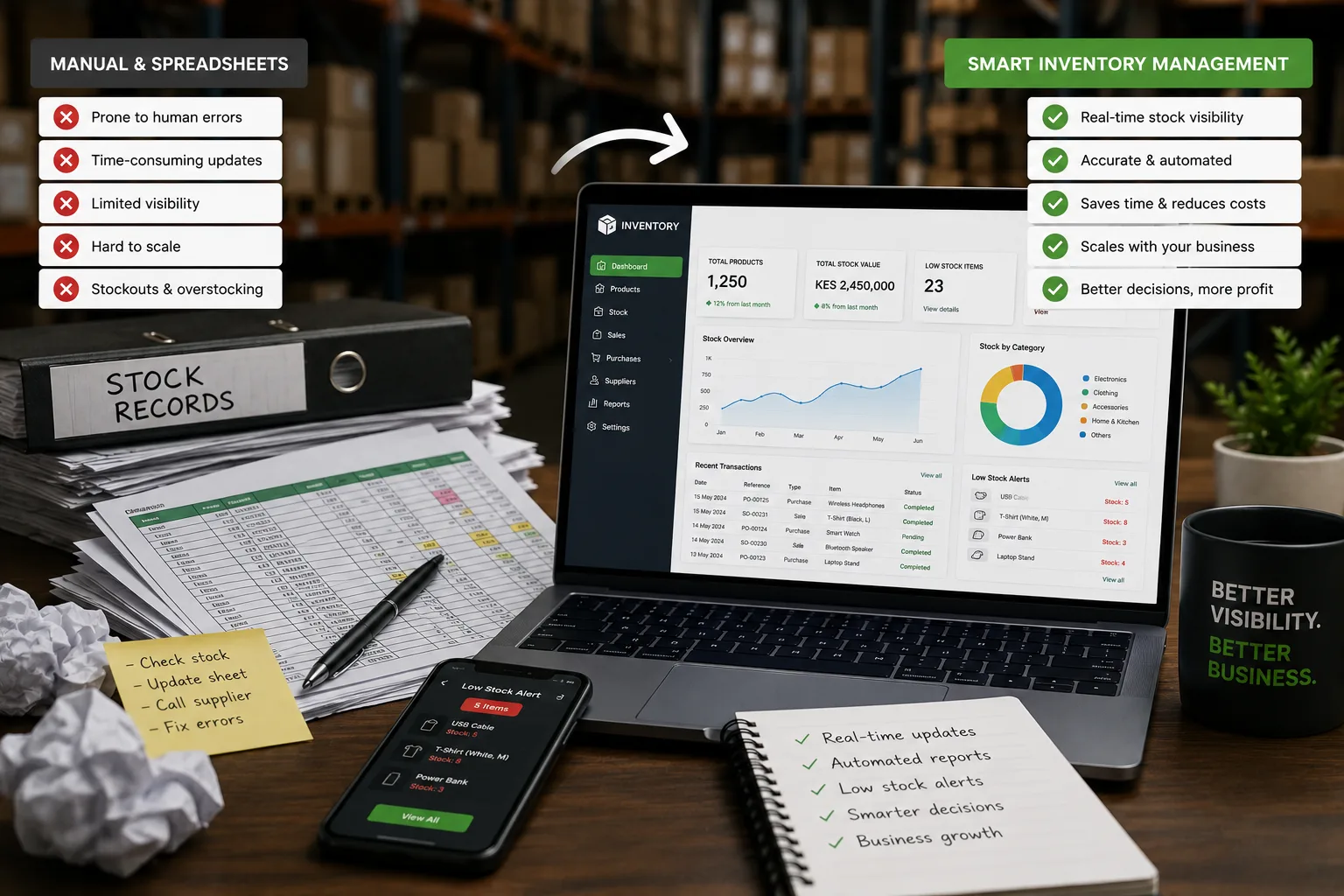
Spreadsheets are a genuinely good starting point for inventory tracking — free, flexible, and familiar. Many successful businesses run on Excel or Google Sheets for years without issue. But there's a point where the very flexibility that made spreadsheets useful becomes a liability: manual entry errors compound, multiple people editing the same file creates version conflicts, and what used to take minutes to update now takes hours.
Recognizing that tipping point early — before it starts costing real money — is the key question this post answers.
Why Spreadsheets Work Well at First
For a small inventory, a single location, and one or two people managing stock, spreadsheets offer real advantages: no software cost, complete flexibility to structure data however makes sense, and no learning curve for a small team already comfortable with Excel or Sheets. There's no need to rush toward dedicated software before the business genuinely needs it.
Warning Signs You've Outgrown Spreadsheets
1. Stock Counts Don't Match Reality
If physical stock counts regularly don't match what your spreadsheet says — a common and costly problem — it's a sign that manual entry, forgotten updates, or version conflicts have made the spreadsheet unreliable as a source of truth.
2. Multiple People Are Editing the Same File
Once more than one or two people need to update inventory simultaneously, spreadsheets become genuinely difficult to manage — overwritten changes, conflicting versions, and unclear "who updated what, when" all become recurring problems.
3. You're Spending Hours on Manual Reconciliation
If a meaningful chunk of someone's week goes into manually reconciling stock counts, cross-checking sales against inventory, or catching entry errors, that time cost alone often justifies moving to a dedicated system.
4. You Can't Get Real-Time Visibility
Spreadsheets are inherently a snapshot, updated whenever someone remembers to do it — not a live, real-time view of stock levels. If your business needs to know current stock at a glance (particularly relevant for e-commerce, where overselling out-of-stock items damages customer trust), this lag becomes a genuine operational risk.
5. You're Managing Multiple Locations or Warehouses
Tracking inventory across more than one physical location in a single spreadsheet — or worse, separate spreadsheets per location — quickly becomes unwieldy and error-prone, especially when stock needs to move between locations.
6. Your Product Range Has Grown Significantly
A spreadsheet that worked well for 50 SKUs often becomes genuinely difficult to navigate and maintain accurately once a business scales to several hundred or more, particularly with variants (sizes, colors) multiplying the row count.
7. You Need Better Reporting and Forecasting
Spreadsheets can technically produce reports, but generating genuinely useful insights — reorder point alerts, sales velocity by product, seasonal demand patterns — typically requires manual formula-building that's fragile and time-consuming to maintain as data grows.
8. Integration With Other Systems Is Becoming a Manual Chore
If inventory data needs to sync with your online store, accounting software, or point-of-sale system, and that syncing currently happens through manual copy-pasting or re-entry, this is a strong signal that dedicated, integrated software would save significant ongoing time and reduce errors.
What a Proper Inventory Management System Provides
- Real-time stock visibility across all locations and sales channels simultaneously
- Automated low-stock alerts, preventing both stockouts and over-ordering
- Barcode or SKU-based tracking, reducing manual entry errors significantly
- Integration with sales channels — e-commerce, POS, accounting — keeping data consistent without manual re-entry
- Reporting and forecasting tools that would be impractical to maintain manually in a spreadsheet
- User permissions and audit trails, so multiple staff can update inventory without the conflicts spreadsheets create
Off-the-Shelf vs Custom Inventory Systems
Off-the-shelf inventory platforms work well for businesses with fairly standard products and processes, offering faster setup and lower upfront cost. Businesses with more specific needs — unusual product categorization, integration with a custom-built e-commerce platform, or particular local requirements like M-Pesa-linked sales tracking — often get better long-term value from a custom-built system designed around their exact workflow. This mirrors the broader decision most growing businesses face, covered in more depth in our guide on off-the-shelf vs custom software for Kenyan SMEs.
Making the Transition Without Disrupting Operations
Moving from spreadsheets to dedicated software doesn't need to happen all at once:
- Start with a clean data migration — auditing and correcting your existing spreadsheet data before importing it, since inaccurate data carried into a new system just creates new problems
- Run both systems in parallel briefly, if feasible, to build confidence in the new system before fully retiring the spreadsheet
- Train your team properly on the new system, since poor adoption undermines even a well-chosen platform
- Start with core functionality — accurate stock tracking and alerts — before adding more advanced reporting or integrations
Is It Worth the Investment?
For a small business with limited inventory and low error rates, spreadsheets may genuinely remain the right tool for longer than expected — there's no need to over-engineer a solution to a problem that isn't yet costing real time or money. But once inventory errors, reconciliation time, or missed sales from stockouts start adding up to a meaningful cost, a proper system typically pays for itself well within the first year through recovered time and reduced errors alone.
Build an Inventory System That Fits Your Business
At Blessedave Technologies, we help Kenyan businesses move beyond spreadsheets with inventory management systems — off-the-shelf or fully custom — built around your actual product range, sales channels, and workflow.
Talk to us about an inventory system for your business at blessedavetechnologies.com.