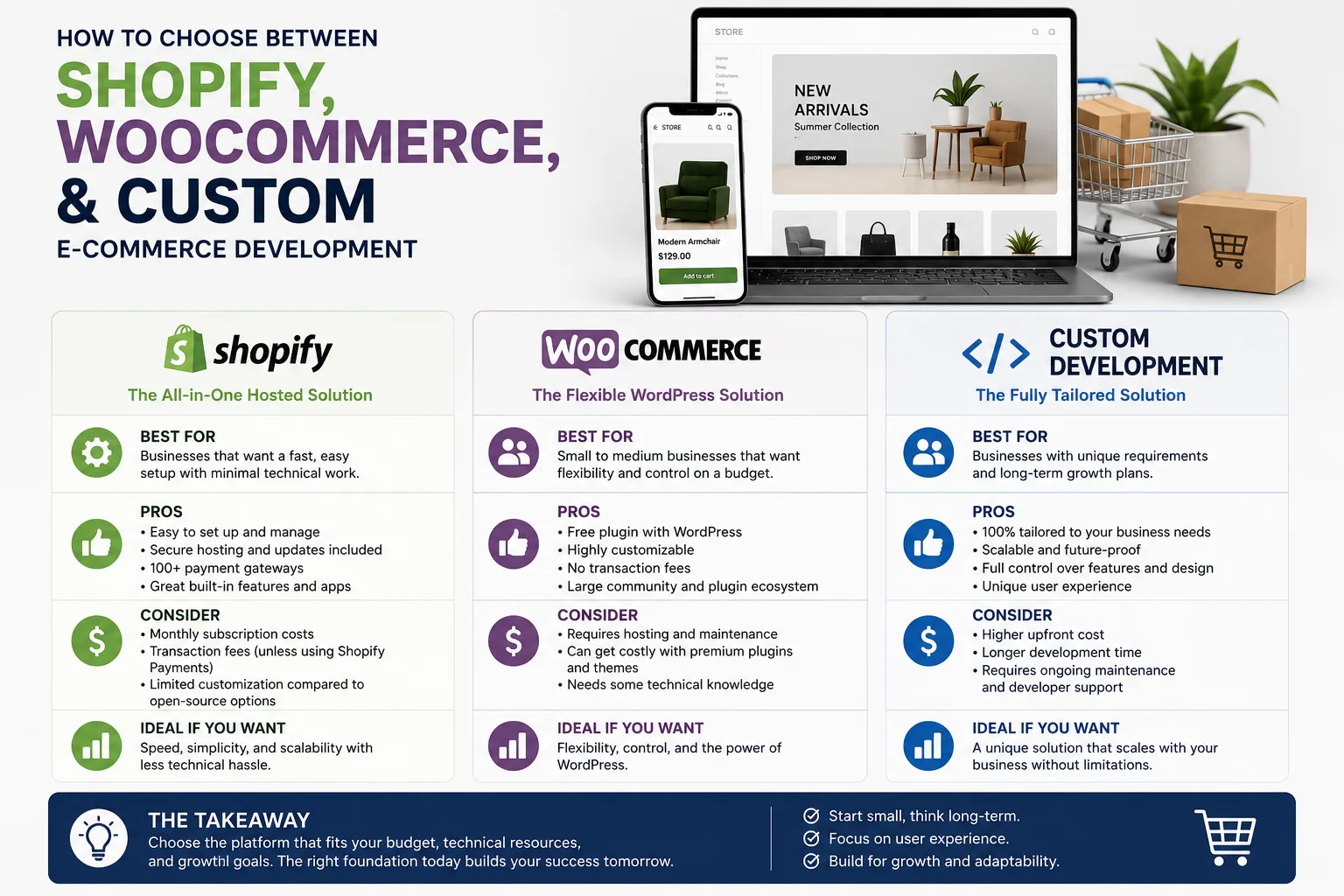
Choosing an e-commerce platform is one of the highest-stakes decisions an online store makes — the wrong choice can mean months of migration work and significant developer costs to reverse later. For Kenyan businesses specifically, there's an added wrinkle most global comparisons don't address: local payment integration, particularly M-Pesa.
Here's a practical, Kenya-focused comparison of the three main paths: Shopify, WooCommerce, and fully custom development.
Shopify: The Fully Hosted, All-in-One Option
Shopify is a hosted platform — you pay a monthly subscription, and Shopify handles hosting, security, and infrastructure entirely. In 2026, Shopify's plans generally range from around $29 to $399+ per month depending on features, with additional apps and transaction fees on top for most stores.
Strengths:
- Fast setup — a store can be live within hours, with no server management required
- Strong built-in sales and inventory features, plus AI-powered tools bundled into recent updates
- Reliable, curated app ecosystem with strong performance and security vetting
- Excellent for merchants who want to focus on selling rather than technical management
Limitations for Kenyan businesses:
- Shopify's native payment system (Shopify Payments) generally isn't available for Kenyan-registered merchants, meaning stores typically rely on third-party payment gateways instead — which usually carry an additional transaction fee on top of the subscription cost
- M-Pesa isn't a native Shopify payment option, so integrating it requires a third-party app or custom workaround rather than a built-in solution
- Less flexibility for highly specific local workflows or unusual checkout requirements
Best fit: Kenyan businesses selling primarily to an international audience, or those prioritizing speed and simplicity over deep local payment customization.
WooCommerce: The Flexible, Self-Hosted Option
WooCommerce is a free, open-source plugin that turns a WordPress site into an online store. Unlike Shopify, there's no platform subscription fee — but you're responsible for hosting, security, updates, and maintenance yourself (or through a developer).
Strengths:
- No licensing fees — costs come from hosting and plugins rather than a mandatory subscription
- Full customization potential through direct code access and WordPress's enormous plugin ecosystem
- Strong content and blogging capabilities, since it inherits WordPress's full CMS — valuable if content marketing and SEO are part of your growth strategy
- More flexibility for integrating local payment gateways, including M-Pesa, through available plugins or custom development
- Full ownership of your data and store, with no platform lock-in
Limitations:
- Requires more setup work upfront — hosting, domain, plugin configuration — and carries an ongoing "maintenance tax" as WordPress, WooCommerce, and plugins all need regular updates
- Performance and security depend heavily on hosting quality and how well the plugin stack is managed
- WooCommerce discontinued its native point-of-sale feature in February 2026, so in-person selling now requires a third-party POS app
Best fit: Kenyan businesses that want more control over local payment integration and content-driven SEO, and either have technical capacity in-house or a reliable development partner to manage ongoing maintenance.
Custom E-commerce Development: Built Entirely Around Your Business
Custom development means building your online store from the ground up — no platform subscription, no plugin dependencies, just a system designed specifically around how your business operates.
Strengths:
- Complete control over functionality, checkout flow, and integrations — including direct M-Pesa Daraja API integration rather than relying on third-party workarounds
- No recurring platform fees or transaction cuts to a third party
- Built to handle unique business logic that generic platforms struggle with — complex pricing structures, unusual product configurations, or industry-specific workflows
- Scales precisely with your business, without hitting platform-imposed limitations later
Limitations:
- Higher upfront cost and longer development timeline compared to Shopify or WooCommerce
- Requires an experienced development partner for both the initial build and ongoing maintenance
- Not necessary for straightforward stores with standard, common requirements
Best fit: Kenyan businesses with specific, non-standard requirements — deep M-Pesa integration, unusual product logic, or plans to scale significantly — where the long-term fit and cost savings outweigh the higher initial investment.
A Practical Decision Framework
Choose Shopify if: you want the fastest path to launch, are comfortable using a third-party payment gateway for M-Pesa, and prioritize simplicity over deep local customization.
Choose WooCommerce if: you want more control over local payment integration and content marketing, and have access to reliable technical support for ongoing maintenance.
Choose custom development if: your business has specific workflow requirements that generic platforms can't accommodate well, or you're planning significant scale where owning your entire stack — including native M-Pesa integration — pays off over time.
The M-Pesa Factor Shouldn't Be an Afterthought
For most Kenyan online stores, this is genuinely one of the most important factors in the decision, not a minor technical detail. We cover the practical tradeoffs of different payment integration approaches in more depth in our guide on payment gateway options for Kenyan online stores — worth reading alongside this comparison before committing to a platform.
Total Cost of Ownership Matters More Than the Sticker Price
It's tempting to compare platforms purely on headline pricing, but the real cost includes hosting, plugins or apps, transaction fees, developer time, and ongoing maintenance. A WooCommerce store can end up costing as much as Shopify once these are all factored in — and a custom build, while higher upfront, can be more cost-effective over several years if it eliminates recurring platform and transaction fees entirely.
Get the Right Recommendation for Your Store
At Blessedave Technologies, we help Kenyan businesses choose — and build — the right e-commerce setup for their specific needs, whether that's a WooCommerce store with proper M-Pesa integration or a fully custom platform designed around your exact workflow.
Talk to us about the right e-commerce platform for your business at blessedavetechnologies.com.