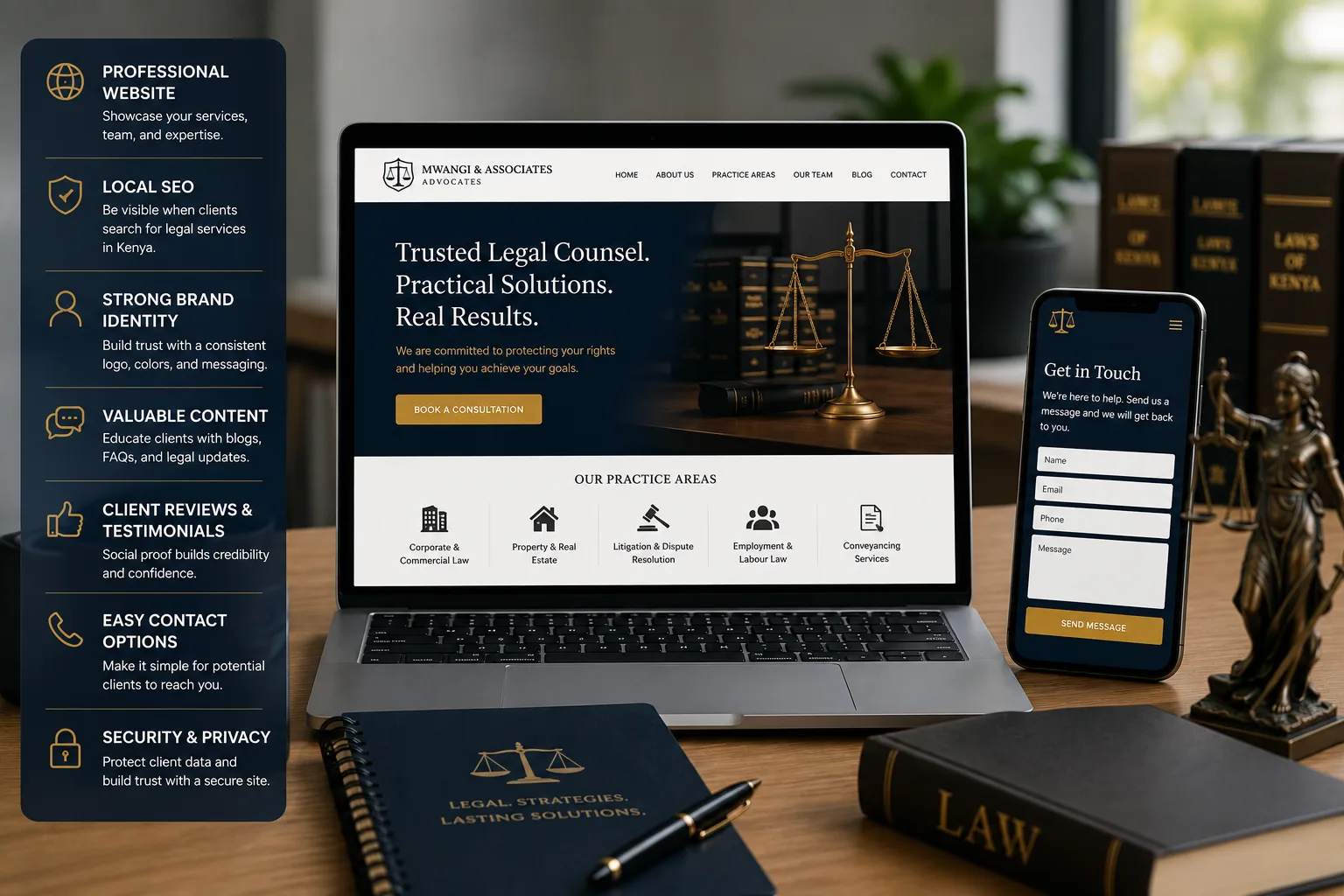
When someone needs a lawyer — whether for a property dispute, a business contract, or a family matter — their first move today is rarely to ask around. It's to search online. For Kenyan law firms, that means your digital presence is often the very first impression a prospective client forms, long before any consultation call.
Yet many law firms still operate with a bare-bones, outdated, or entirely absent website — a significant missed opportunity in a profession built almost entirely on trust and reputation. Here's what a proper digital presence actually requires.
Why Digital Presence Matters More for Law Firms
Legal services are a high-trust, high-stakes purchase. Clients are evaluating competence, credibility, and discretion — often under real personal or business stress — and they're doing much of that evaluation online before ever picking up the phone. A weak or missing digital presence doesn't just fail to help; it actively raises doubt at exactly the moment a firm needs to project confidence.
The Essentials Every Law Firm Website Needs
1. Clear Practice Area Pages
Rather than a single vague "Our Services" page, dedicated pages for each practice area — conveyancing, corporate law, family law, litigation, employment law — help prospective clients quickly confirm the firm handles their specific type of matter, and give search engines specific, rankable content for each area.
2. Named Advocate Profiles
Prospective clients want to know who they'd actually be working with. Profiles for individual advocates — photo, qualifications, areas of specialization, years of call to the bar — build far more confidence than an anonymous "Our Team" page, and help clients self-select toward the right person for their specific matter.
3. Clear, Professional Credibility Signals
Law Society of Kenya (LSK) membership, relevant certifications, notable case types handled (without breaching client confidentiality), and any recognitions or affiliations all reinforce legitimacy for a profession where trust is the primary currency.
4. Easy, Direct Contact Options
A prominent phone number, a simple consultation request form, and clear next steps remove friction at the exact moment a hesitant prospective client decides to reach out — often after a stressful triggering event like a dispute, a business deal, or a family matter.
5. A Genuinely Useful Legal Insights Section
A regularly updated blog covering practical, accessible topics — property transfer basics, employment contract essentials, common legal pitfalls — demonstrates real expertise while also helping the firm appear in search results exactly when potential clients are researching a relevant issue. This is one of the areas where our Juma Auditors case study offers a useful parallel, even though it's an audit firm rather than a law firm — the same trust-building principle applies directly to legal services.
6. Mobile-Friendly, Fast-Loading Design
Many prospective clients will first encounter a law firm's website from a phone, often while dealing with an urgent matter. A slow or poorly optimized mobile experience can lose that inquiry before it even reaches a contact form.
7. Transparent Information About the Consultation Process
Clarifying what happens after someone reaches out — an initial consultation fee (or lack thereof), what to expect, typical response times — reduces hesitation for clients unfamiliar with how engaging a lawyer actually works.
What to Avoid
- An outdated, template-feeling website that undercuts the credibility a law firm needs to project
- Overly generic, jargon-heavy copy that fails to clearly explain what the firm actually does for a non-legal audience
- No clear differentiation between advocates or practice areas, making it hard for a specific client need to find the right fit within the firm
- Slow or non-existent response to online inquiries, which can quickly undermine the trust a well-built website initially establishes
SEO Considerations Specific to Law Firms
Legal search terms are often highly specific and localized — "conveyancing lawyer Nairobi," "employment law advocate Westlands." Structuring practice area pages and blog content around these specific, realistic search terms (rather than generic industry language) significantly improves a firm's chances of being found by clients actively searching for exactly the kind of help they offer. This same structured, question-focused approach also improves visibility in AI-powered search tools, which we cover in more depth in our guide on getting your business mentioned by ChatGPT and Google AI.
A Realistic Starting Point
Not every firm needs to build all of this at once. A practical starting sequence:
- A clean, professional website with clear practice area pages and advocate profiles
- Basic local SEO — a claimed Google Business Profile and consistent contact information across platforms
- A modest but consistent content section — even a handful of well-written, practical articles — published and expanded over time
- Ongoing refinement based on which pages and content actually drive inquiries
Build a Digital Presence Your Firm Can Be Proud Of
At Blessedave Technologies, we build websites for law firms and other professional services firms designed specifically to project credibility, showcase expertise, and convert cautious, high-stakes visitors into scheduled consultations — informed by real client work like our Law Firm projects.
Talk to us about your law firm's digital presence at blessedavetechnologies.com.