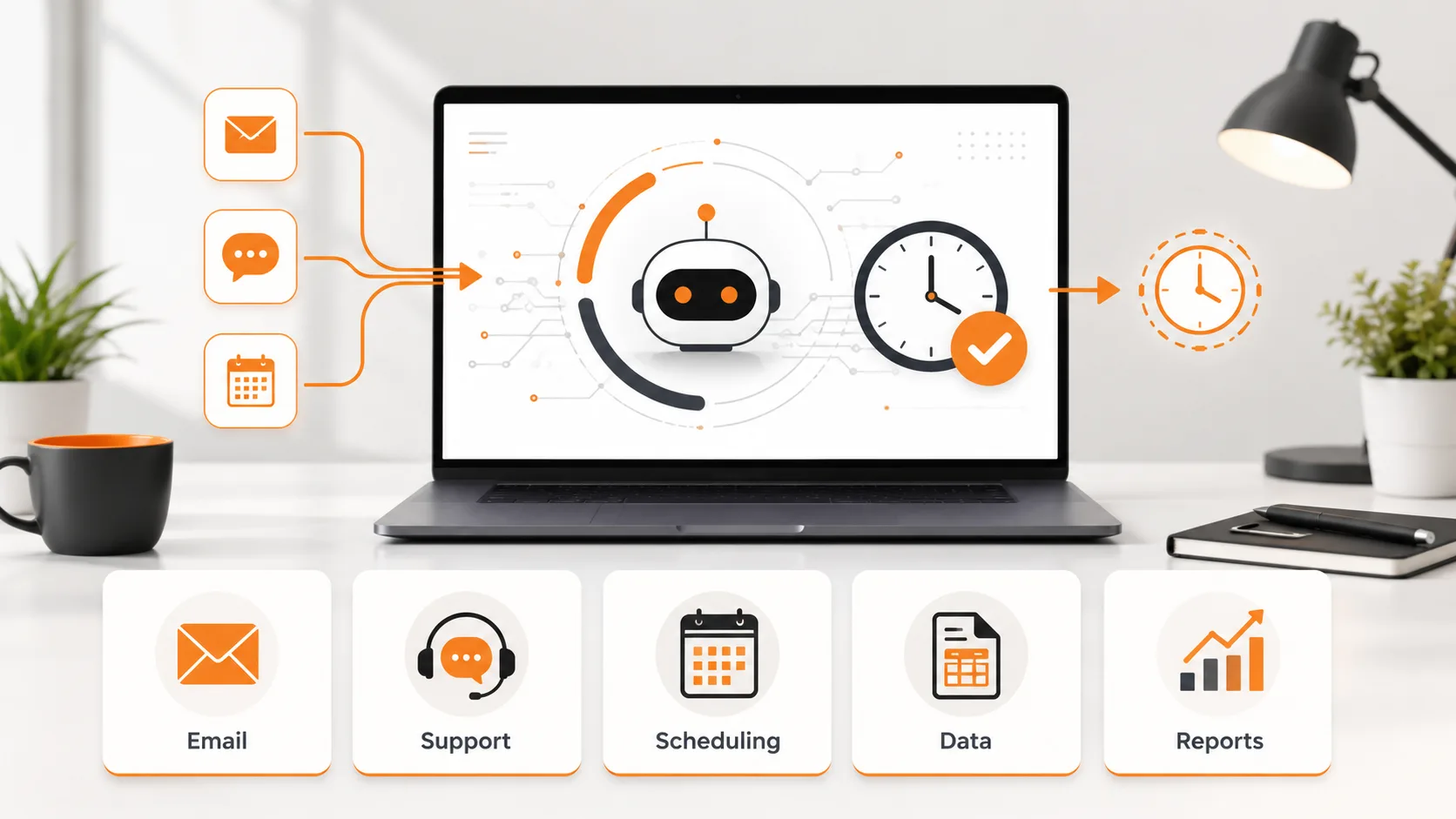
If you or your team are still manually answering the same customer questions, re-entering the same data, or chasing the same follow-ups every single week, you're spending hours on work that technology can now handle for you.
AI automation isn't just for large corporations with big IT budgets anymore. Practical, affordable automation tools are now within reach for Kenyan SMEs — and the time savings can be significant. Here are five concrete ways AI automation can free up hours in your business every week.
1. Automated Customer Inquiry Responses
If your team spends hours each week answering the same repetitive questions — business hours, pricing, availability, delivery timelines — an AI-powered chatbot can handle the bulk of these instantly, any time of day. Instead of a customer waiting for a reply during business hours, they get an immediate answer, and your team only steps in for the questions that genuinely need a human touch.
Time saved: Hours per week previously spent on repetitive replies across WhatsApp, email, or website chat.
2. Automated Appointment and Booking Management
For businesses that rely on bookings — clinics, salons, consultants, tour operators — manually confirming appointments, sending reminders, and handling rescheduling by phone or WhatsApp eats up significant admin time. An automated booking system can handle confirmations, send reminder messages, and even manage rescheduling without a staff member touching every single request.
Time saved: Reduced no-shows and hours of back-and-forth scheduling communication.
3. Automated Data Entry and Document Processing
Manually transferring information from invoices, forms, or receipts into a spreadsheet or system is slow and error-prone. AI-powered tools can extract and organize this data automatically — pulling details from a scanned invoice directly into your accounting system, for example, rather than requiring someone to retype it line by line.
Time saved: Hours of manual data entry, plus a reduction in costly transcription errors.
4. Automated Follow-Ups and Lead Nurturing
Sales opportunities are often lost simply because no one followed up in time. AI-driven automation can send timely follow-up messages to leads who filled out a form, abandoned a cart, or requested a quote — keeping the conversation warm without a salesperson manually tracking every single contact in a spreadsheet.
Time saved: Hours spent manually tracking and remembering follow-ups, plus recovered sales that would otherwise go cold.
5. Automated Reporting and Insights
Pulling together weekly or monthly reports — sales figures, website traffic, customer inquiries — manually from multiple sources takes real time, especially when it's done by hand in spreadsheets. Automation tools can pull this data together and generate reports automatically, giving business owners a clear picture without anyone spending an afternoon compiling numbers.
Time saved: Hours of manual reporting work, freeing up time for actual decision-making instead of data-gathering.
Getting Started with AI Automation: A Realistic Approach
AI automation doesn't need to mean overhauling your entire business overnight. The most effective approach for most Kenyan SMEs is:
- Identify the most repetitive task your team does every single week
- Start with one automation targeting that specific task
- Measure the time saved before expanding to additional processes
- Keep a human in the loop for anything requiring judgment, empathy, or a personal touch
This incremental approach avoids the common mistake of trying to automate everything at once, which often leads to poorly implemented systems that create more problems than they solve.
A Word of Caution
AI automation works best as a support system, not a full replacement for human interaction — especially in customer-facing roles where trust and relationship matter. The goal isn't to remove people from the process; it's to remove the repetitive, low-value tasks so your team can spend their time on the work that actually needs a human — building relationships, solving unusual problems, and making judgment calls.
Start Automating with Blessedave Technologies
At Blessedave Technologies, we help Kenyan businesses identify where AI automation can genuinely save time — whether that's a customer service chatbot, an automated booking system, or a workflow that connects your existing tools together.
Talk to our team about automating your business processes at blessedavetechnologies.com.