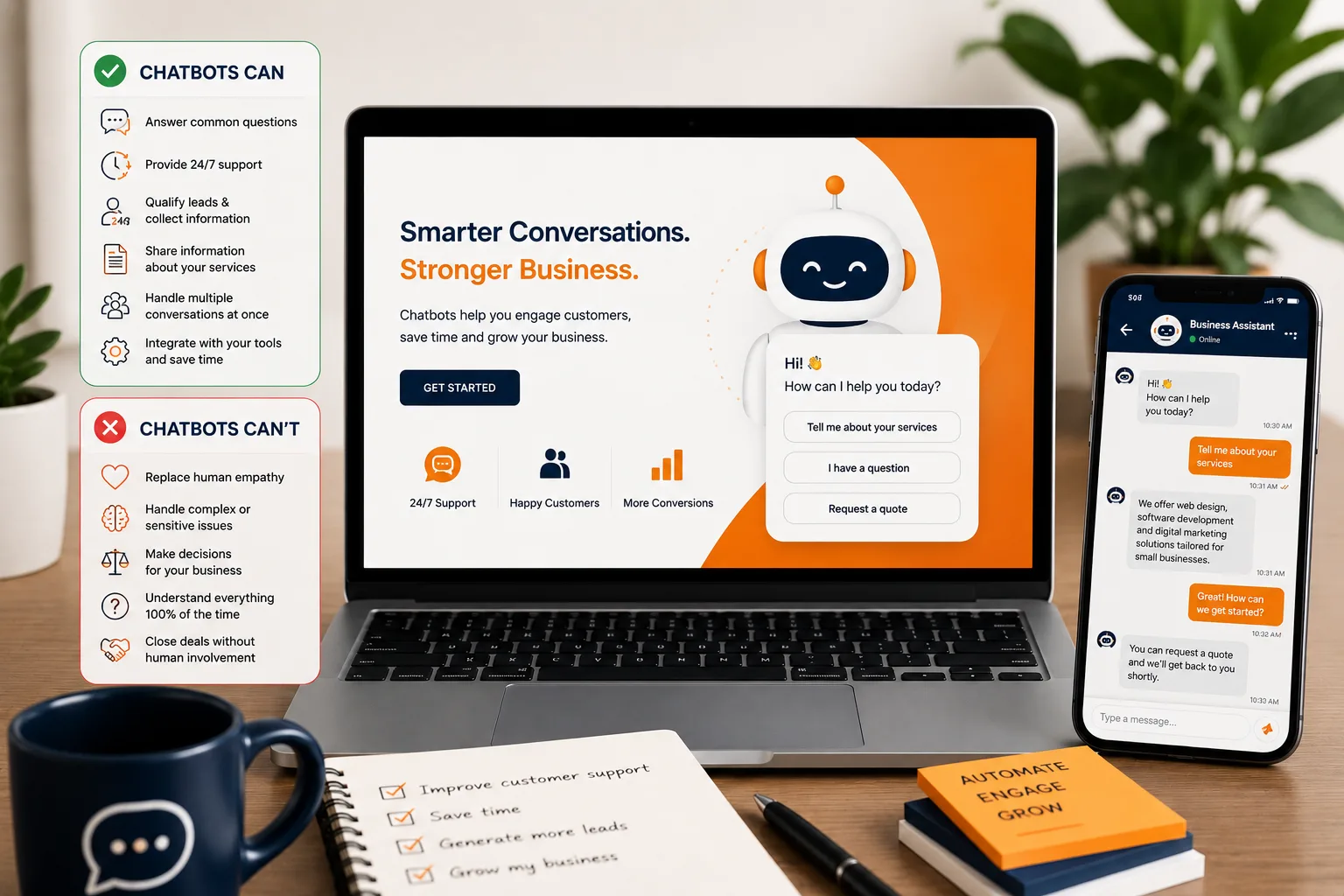
Chatbots have gone from a novelty to a genuinely useful business tool over the past few years — but they've also been oversold. Some businesses expect a chatbot to fully replace customer service; others dismiss them entirely as gimmicky and impersonal. The reality sits in between: chatbots are excellent at specific, well-defined tasks, and genuinely poor at others.
Here's a clear-eyed look at what a chatbot can realistically do for a small business — and where it's better to keep a human in charge.
What Chatbots Can Do Well
1. Answer Repetitive, Predictable Questions
Business hours, pricing ranges, service availability, delivery timelines, location details — these are the questions customer service teams answer dozens of times a week. A well-built chatbot handles these instantly, any time of day, freeing your team from repeating the same answers over and over.
2. Qualify Leads Before a Human Gets Involved
A chatbot can ask basic qualifying questions — what service someone needs, their budget range, their timeline — before routing them to a sales team member. This means your team spends time on leads that are already somewhat pre-sorted, rather than starting every conversation from zero.
3. Provide 24/7 Availability
Customers don't only have questions during business hours. A chatbot can provide immediate responses outside working hours — even if it's simply confirming receipt of an inquiry and setting expectations for a follow-up — rather than leaving a visitor with no response until the next business day.
4. Handle Simple Transactions
For straightforward tasks — booking an appointment, checking order status, providing a tracking update — a chatbot can often complete the entire interaction without human involvement, particularly when connected to a booking or order management system.
5. Reduce Response Time on WhatsApp and Website Chat
Many Kenyan customers reach out via WhatsApp expecting a quick reply. A chatbot integrated into WhatsApp or website chat can provide that immediate first response, even if a human eventually takes over for anything more complex.
What Chatbots Can't Do Well (Yet)
1. Handle Genuinely Complex or Unusual Situations
Chatbots work well within the boundaries of what they're designed to handle. A customer with an unusual complaint, an emotionally charged complaint, or a situation that doesn't fit standard categories will quickly frustrate both the customer and the chatbot if there's no smooth path to a human.
2. Replace Genuine Relationship-Building
For high-trust, high-value interactions — closing a significant sale, resolving a serious complaint, building an ongoing client relationship — customers generally still want to feel they're dealing with a person who understands their specific situation, not a script.
3. Understand Nuance and Tone Perfectly
Even advanced AI chatbots can misread sarcasm, frustration, or ambiguous phrasing, potentially giving an answer that's technically correct but tone-deaf to how the customer is actually feeling in the moment.
4. Function Well Without Proper Setup
A chatbot is only as good as what it's been given to work with. Poorly written responses, outdated information, or a bot that wasn't properly configured for your specific business will frustrate customers faster than having no chatbot at all — this is a common and avoidable failure mode.
5. Fully Replace a Support Team
Even the best-implemented chatbots typically handle a portion of inquiries — often the more routine, repetitive ones — while genuinely complex or sensitive issues still need a person. Businesses that try to eliminate human support entirely usually end up frustrating customers who need real help.
Where Chatbots Deliver the Most Value
Based on how businesses actually use them successfully, chatbots tend to perform best for:
- E-commerce — order status, delivery tracking, product availability questions
- Service businesses with bookings — appointment scheduling, confirmations, reminders
- Businesses with high volumes of repetitive inquiries — pricing, hours, service areas
- Lead qualification — sorting inquiries before they reach a sales team
They tend to add less value for businesses where every interaction is genuinely unique and relationship-dependent, such as bespoke consulting or highly personalized services — though even these businesses can benefit from a chatbot handling the initial, more routine parts of an inquiry.
Getting Chatbot Implementation Right
- Start narrow. Focus the chatbot on a small, well-defined set of tasks rather than trying to have it handle everything from day one.
- Always provide an easy path to a human. A visible option to speak with a real person prevents frustration when the chatbot reaches its limits.
- Keep information updated. A chatbot quoting outdated pricing or hours does more harm than good — treat its knowledge base as something that needs regular maintenance.
- Monitor real conversations. Reviewing actual chatbot interactions reveals where it's succeeding and where customers are getting stuck, so it can be improved over time.
A Practical Middle Ground
The most effective approach for most small businesses isn't "chatbot instead of humans" or "humans instead of chatbots" — it's a chatbot handling the predictable, repetitive first layer of interaction, with a clear, easy handoff to a human whenever the conversation moves beyond that. This is one of several ways AI automation can genuinely save a business time, alongside other applications we cover in our guide on 5 ways AI automation can save your business hours every week.
Implement a Chatbot That Actually Helps
At Blessedave Technologies, we help Kenyan businesses implement chatbots — on websites, WhatsApp, or both — designed around what they're genuinely good at, with a smooth handoff to your team for anything that needs a human touch.
Talk to us about adding a chatbot to your business at blessedavetechnologies.com.