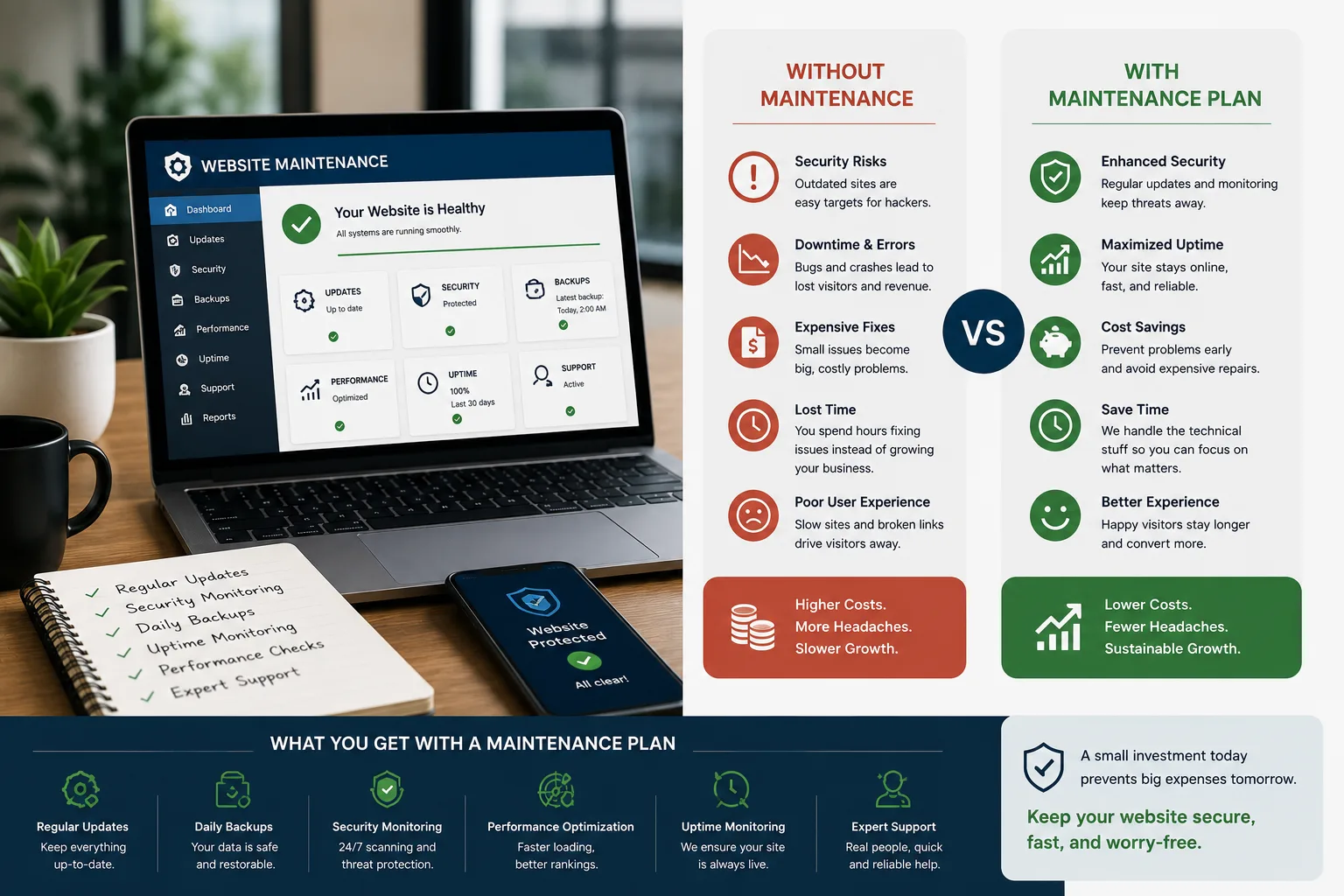
Once a website launches, it's tempting to treat it as finished — a one-time project rather than an ongoing responsibility. Many businesses skip maintenance to save money, only to face an expensive, disruptive crisis months or years later: a security breach, a broken checkout, or a site that simply stops working after a routine software update elsewhere breaks something unexpected.
Website maintenance isn't a luxury add-on — it's the difference between a small, predictable monthly cost and a large, unpredictable emergency bill. Here's why.
What "Website Maintenance" Actually Covers
Ongoing website maintenance typically includes:
- Software and plugin updates — keeping the underlying platform (WordPress, e-commerce plugins, custom code dependencies) current and secure
- Security monitoring and patching — addressing vulnerabilities before they're exploited, not after
- Regular backups — ensuring a recent, restorable copy of the site exists if something goes wrong
- Uptime monitoring — catching outages quickly rather than discovering them from a customer complaint
- Performance optimization — keeping load times fast as content and traffic grow over time
- Minor content updates and bug fixes — small ongoing adjustments that keep the site accurate and functional
- Broken link and error checking — catching issues before they affect a meaningful number of visitors
The Real Cost of Skipping Maintenance
Security Vulnerabilities Compound Over Time
Outdated software is one of the most common ways websites get compromised — hackers actively scan for sites running known-vulnerable versions of common platforms and plugins. A site left unpatched for months or years becomes an increasingly attractive, easy target, and a security breach is almost always more expensive and disruptive to fix than the maintenance that would have prevented it.
Downtime Directly Costs Revenue
Every hour an e-commerce site is down, or a business website is inaccessible, represents lost sales, lost leads, and potentially lost customer trust — particularly costly if the outage happens during a peak period and goes unnoticed for hours because no one was actively monitoring uptime.
Small Issues Become Big, Expensive Problems
A minor bug or outdated dependency, left unaddressed, often compounds into a larger, more complex (and more expensive) problem over time — similar to skipping routine car maintenance until a small issue causes major mechanical failure.
Emergency Fixes Cost More Than Planned Maintenance
Fixing a website in crisis mode — after a hack, after a critical breakage, after a hosting failure — is almost always significantly more expensive and stressful than the equivalent preventive maintenance would have been, both in direct cost and in the business disruption involved.
SEO Rankings Can Silently Erode
A site that becomes slow, develops broken links, or experiences intermittent downtime over time can see its search rankings gradually decline — a slow, hard-to-notice cost that erodes the value of the SEO investment already made in the site.
A Realistic Comparison
Consider two scenarios over a two-year period:
With a maintenance plan: A predictable, modest monthly cost covers updates, security monitoring, and backups. Minor issues are caught and fixed quickly, before they affect visitors or require emergency intervention.
Without a maintenance plan: No ongoing cost for months, until a security breach or critical failure requires emergency, often rushed, remediation — frequently costing significantly more than the maintenance that would have prevented it, on top of the revenue lost during the downtime itself.
The apparent "savings" from skipping maintenance are usually an illusion — they simply defer a larger, less predictable cost to an unknown future date, often at the worst possible time.
What to Look for in a Maintenance Plan
- Regular, verified backups — not just automated backups that no one confirms are actually working
- Proactive security monitoring, not just reactive fixes after something has already gone wrong
- Clear response times for urgent issues, so you know what to expect if something breaks
- Regular reporting, so you have visibility into what's being maintained and why
- Scalable scope — a plan that can expand as your site grows in complexity or traffic
Is Maintenance Necessary for Every Website?
Even simple, low-traffic websites benefit from basic maintenance — security patches and backups matter regardless of site size, since vulnerabilities are often exploited automatically at scale rather than through deliberate, targeted attacks. That said, the appropriate scope of a maintenance plan should reasonably match the complexity and business-criticality of the site — a simple brochure site has different needs than an active e-commerce platform processing daily transactions.
Build Maintenance Into Your Website Budget From the Start
Businesses that plan for ongoing maintenance costs from the beginning — rather than treating a website as a one-time expense — tend to have significantly more stable, secure, and better-performing sites over time, with fewer unpleasant surprises and lower total cost of ownership across the site's lifespan.
Protect Your Website Investment With Blessedave Technologies
At Blessedave Technologies, we offer ongoing website maintenance plans — covering updates, security monitoring, backups, and performance optimization — so your website stays secure, fast, and reliable long after launch, without the risk of a costly emergency down the line.
Talk to us about a maintenance plan for your website at blessedavetechnologies.com.